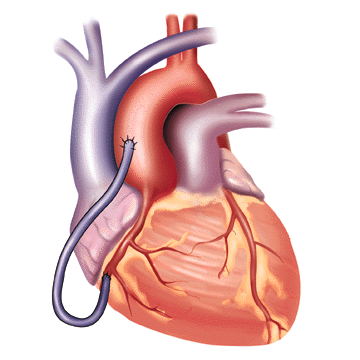
Human Hemoglobin May Turn Staph Aureus Bacteria Deadly, Researchers Find
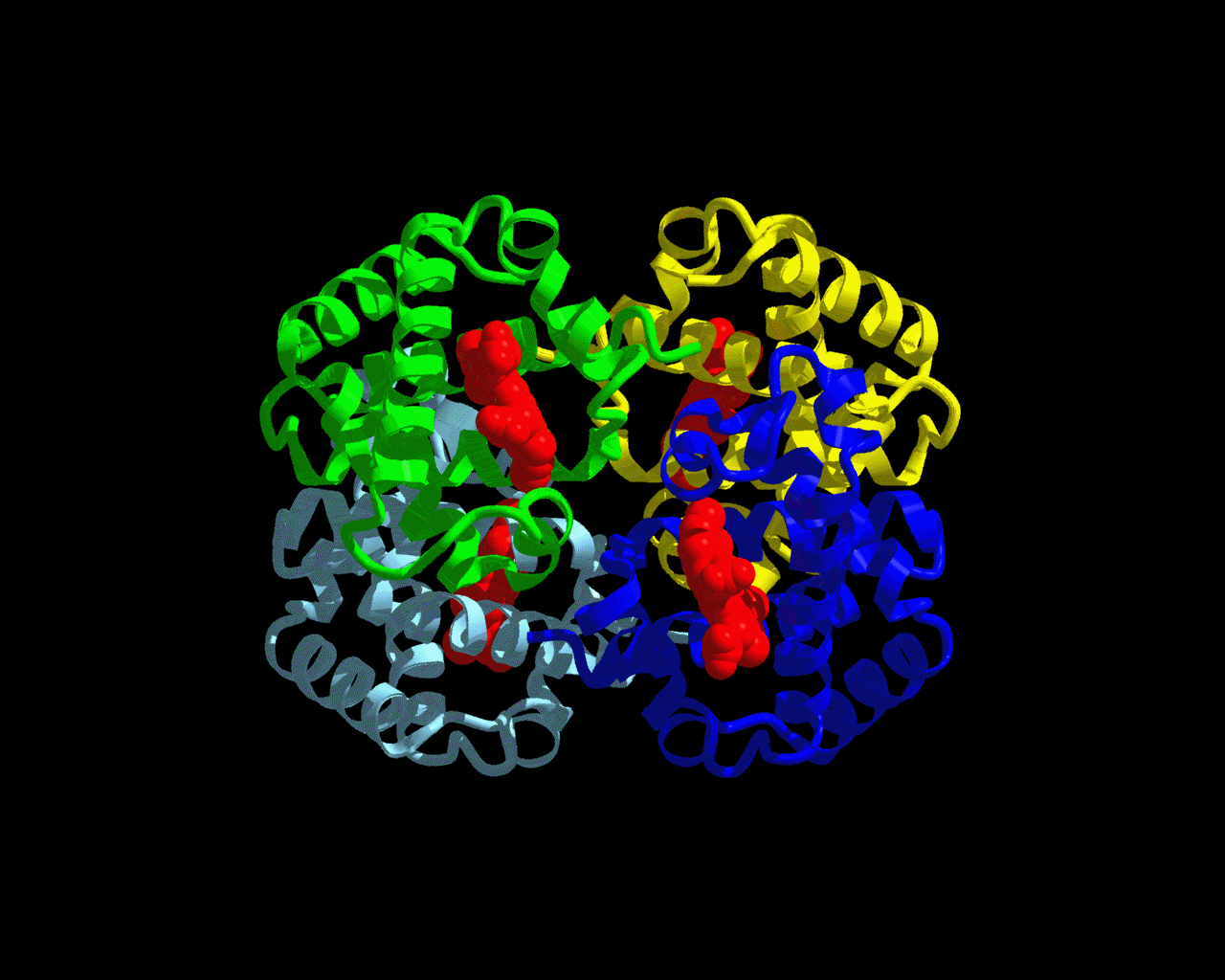
Human hemoglobin, the oxygen carrying protein in red blood cells, is the most efficient fuel for Staphylococcus aureus infections, according to a study that may help clarify how the bacteria homes in on certain patients with deadly consequences.

Hemoglobin also contains the iron needed for bacteria to develop and spread. Researchers led by Gleb Pishchany from Vanderbilt University Medical School’s microbiology department showed in laboratory testing how Staph aureus latches on more simply to hemoglobin from humans than other mammals to cause invasive infections.


Exercise prevents middle-age weight gain


A new research has revealed that young adults, mainly women, who maintained high levels of moderate and vigorous activity over a period of 20 years experienced smaller gains in weight and waist circumference during the transition from young adulthood to middle age, compared to individuals with lower activity levels.

Arlene L. Hankinson, of the Feinberg School of Medicine, Northwestern University, Chicago, and colleagues conducted a research to evaluate the relationship between maintaining higher activity levels and changes in body mass index (BMI) and waist circumference over 20 years in youthful adults.


Low-Sugar Cereals Help Kids Eat Healthier

Children are more likely to eat a nutritious, balanced breakfast if they give low-sugar cereals, even if they add a little table sugar to their bowls, a new study says.

Though children may favor cereal that’s high in sugar, they’re more likely to eat fruit at breakfast when served a cereal containing less sugar, researchers say.

The research observed what 91 children aged 5 to 12 at a summer day camp ate when served either high-sugar or low-sugar cereals.


Stem Cells Used to Make Pancreas, Gut Cells

Stem cells can be transformed into the pancreatic cells needed to treat diabetes and into difficult layers of intestinal tissue, scientists demonstrated in two experiments reported on Sunday.

In one, a team turned immature sperm cells into pancreatic tissue, while another group turned embryonic stem cells into complex layers of intestinal tissue.

Both studies show latest ways to use stem cells, which are the body's master cells and which can come from a variety of sources.


Chronic Lyme disease: A dubious diagnosis

Dr. Bernard Raxlen arrived at Manhattan's glamorous Gotham Hall on a cool autumn night in 2008 to get a humanitarian award.

With a lime-green Lyme disease advocacy ribbon pinned to his dapper black suit, Raxlen joined partygoers sipping martinis below a stained-glass skylight bigger than most New York City apartments.Money was in the air. The "Unmask A Cure" gala invitation listed Goldman Sachs, New York Private Bank & Trust and Marquis Jet as sponsors. The event increased money for the Turn the Corner Foundation, a Lyme nonprofit on whose medical advisory board Raxlen sat.

The scene was light-years from the institutional brick building where the Connecticut Medical Examining Board was considering disciplinary action against Raxlen for the fourth time in 10 years. Raxlen had been accused of telling a lady dying of Lou Gehrig's disease that she had chronic Lyme disease, an illness that might not even exist.


Heart trouble? Blood test to tell years in advance

A new blood test may be able to tell whether a seemingly strong person is at risk of dying from heart disease , US researchers said.

An older , less sensitive version of the test detects a certain protein in only a small percentage of people ,but a research of the newer test made by Roche found it in about 25% of 3,500 blood samples .And people who had detectable levels of the protein , released by damaged heart muscle , were nearly seven times more likely to die of heart disease within six years.

Both tests look for a protein called cardiac troponin T, which indicates muscle damage in the heart , but the newer test called Elecsys Troponin T is 10 times more sensitive . "This test is among the most powerful predictors of death in the common population we've seen so far ," saidJ amesdeLemosof theUniversity of Texas Southwestern Medical Center in Dallas , whose study appears in the Journal of the American Medical Association .


Shellfish may help preserve seniors' eyesight

Eating foods rich in omega-3 fatty acids, such as salmon and tuna, seems to be fine for not only the heart and mind but the eyes. A latest study adds shellfish to that group. It found that seniors who ate at least one serving a week of fish or shellfish high in omega-3s reduced their risk of developing advanced age-related macular degeneration, a disease that affects vision, by 60 percent.

The findings are consistent with mounting proof that high levels of dietary omega-3 fatty acids benefit eye health, the researchers said.

"But, unlike earlier studies, we included shellfish intake in the determination of omega-3 fatty acid consumption," said researcher Bonnielin K. Swenor of the Wilmer Eye Institute at John Hopkins University. "This is main because shellfish, particularly crab and oysters, are a main component of the diet" of the study population.


Brain Scan Might Someday Spot Autism

A kind of brain imaging that measures the circuitry of brain connections may someday be used to diagnose autism, new research suggests.

Researchers at McLean Hospital in Boston and the University of Utah used MRIs to analyze the microscopic fiber structures that create the brain circuitry in 30 males aged 8 to 26 with high-functioning autism and 30 males without autism.

Males with autism showed differences in the white matter circuitry in two regions of the brain's temporal lobe: the superior temporal gyrus and the temporal stem. Those parts are involved with language, emotion and social skills, according to the researchers.


Fat-fearing moms putting babies on diets

If you've ever wondered how crazy America's obsession with weight can get, look no further than this strange trend among some fat-fearing parents, mothers who put their babies on diets.

And I'm not talking about pudgy 10-year-olds who think Wii Fit passes for work out. I'm talking babies, under a year old, with chubby cheeks and folds in their thighs — you know, the kind most other people coo over as the picture of health.

According to a recent Good Morning America report, and some Mommy blogs, pediatricians around the country are finding that "more and more parents are putting their babies on diets," even diluting their nutrient-rich principle and breast milk with water, to keep them from getting "fat."

The fear itself is not far-fetched. Dieting babies come at a moment in America's ballooning child obesity epidemic when one in 10 children below the age of 2 is overweight, and experts have come up with a new term to describe the heaviest: "the super-obese," according to the ABC story. So parents today are more consumed than ever with their babies' girth.


New vitamin D recommendations


Despite mounting pressure to urge several Americans to sharply boost their vitamin D levels, latest government recommendations are not advocating a huge increase in the amount of the "sunshine vitamin" that people get.

The United States and Canada asked the Institute of Medicine, which is division of the National Academy of Sciences, to update the official vitamin D recommendations for the first time since 1997. A 14-member expert committee convened for the task concluded that most Americans and Canadians up to age 70 need no more than 600 international units of vitamin D per day. The elderly may need as much as 800, the committee concluded.

Before, experts called for children and younger adults get 200 international units a day, adults ages 50 to 70 get 400 and the aged to get 600. But a flurry of research indicating that vitamin D may have a dizzying array of health benefits, and that many people may have insufficient levels, had reignited an intense debate over whether federal guidelines were outdated, leaving millions unnecessarily vulnerable to heart disease, cancer, diabetes, infections and other ailments. Some doctors have begun routinely testing their patients' vitamin D levels and recommeding that people should routinely consume 2,000 or 3,000 international units a day. Sales of vitamin D supplements have raised sharply in recent years.


If you're around a baby, get whooping cough vaccine

Most Georgia infants get the vaccines they require to help protect them from pertussis -- a highly contagious disease better known as whooping cough.

While Georgia has not observed high rates of the disease so far this year, outbreaks in other states are prompting public health officials to say another time that a vaccine for the baby isn’t enough. They advise all adults and teens who come into contact with an infant to roll up their sleeve and get a vaccine, too.

The advisory applies not just to parents, but to adolescent siblings, aunts, uncles, grandparents and day care employees anyone who is going to spend time with the baby.

“What we want to have people do is make a cocoon of immunity around the infant,” said Jeff Diamond, a spokesman for the Atlanta-based Centers for Disease Control and Prevention.


More Protein, Fewer Refined Carbs May Keep Weight Off

If you've worked hard to shed those additional pounds and want to keep the weight off, a new Danish study suggests that you consider eating more protein and fewer refined carbohydrates.

Based on the findings, the researchers recommend consuming mostly what's known as low-glycemic index carbohydrates, such as whole-grain breads. The glycemic index (GI) is a measure of the ability of carbohydrates to raise blood glucose levels; those with a low GI cause blood levels to raise more slowly, explained Dr. Thomas Meinert Larsen, a co-author of the study, published in the Nov. 25 issue of the New England Journal of Medicine.

What is it about the high protein, low glycemic index carbohydrate diet that maintains weight under control? "Possibly a stronger satiating effect and more balanced blood sugar regulation," Larsen hypothesized.


Eating orange and dark green vegetables linked to longer life

This time no beta-carotene in vegetables that has the spotlight, but rather its cousin: alpha-carotene. Both are members of the carotenoid antioxidant family. Scientists trust carotenoid antioxidants promote health by counteracting oxygen-related damage to DNA.

Consumption of fruits and vegetables has long been associated with lower risks of health troubles such as cancer and heart disease, said Dr. Chaoyang Li of the U.S. Centers for Disease Control and Prevention, in Atlanta, in e-mail to Reuters Health.

However, it is still not understandable which elements contribute to the health effects or how they do so, he added, pointing to recent studies that have found no apparent benefit for beta-carotene supplements.

To investigate the merits of oft-ignored alpha-carotene, Li and his colleagues analyzed information on more than 15,000 people who were participating in the Third Nationwide Health and Nutrition Examination Survey Follow-up Study. All of them provided blood samples at the start of the study, along with other medical and lifestyle information.


Many fat women think they are slim: research


An American study questioned over 2,000 women about their size, diet and work out habits and took measurements. It found that many women were often unaware about whether they were a healthy weight or not.

Co-author Dr Mahbubur Rahman, of University of Texas, said: "As obesity numbers climb, many women see overweight as normal, not based on the scale but on how they view themselves."

It was found that 25 per cent of overweight women misjudged their body weight along with 16 per cent of common weight women.

The study was published in the journal Obstetrics and Gynaecology.

The findings have serious consequences for obesity prevention, the researchers said, as many women do not recognise they are overweight and so will not connect programmes.

The study found that Hispanic and African American women who were overweight thought they were healthy compared with 15 per cent of white women.

The trend was reversed for common weight women who thought they were overweight with fewer Hispanics and African Americans falling into this category than white women.

Healthy weight women who thought they were too fat were twice as likely to skip meals, diet and smoke more cigarettes than the overweight women who thought they were slim.


Facebook Heartbreak Leads to Man's Asthma Attacks

We often hear that social networks can be fine for emotional health by reconnecting us with old friends, helping us build professional contacts and countering isolation, but Italian doctors have reported a case where logging onto Facebook made an 18-year-old man hyperventilate.

The patient, whose asthma was well-controlled with steroid inhalers and Singulair pills, began having more asthma attacks when he logged onto Facebook and learned that his ex-girlfriend had un-friended him and friended "several new young men." Frustrated by being cut off from his former flame, the jilted boyfriend became her Facebook friend under a nickname and regained access to her profile picture.

However, the sight of her picture left him hyperventilating and short of breath, "which happened repeatedly" as he called up her profile, wrote Dr. Gennaro D'Amato, a respiratory and allergy specialist at the High Specialty Hospital A Cardarelli in Naples, Italy, in this week's issue of The Lancet.


6,795 Reported Cases Of Whooping Cough In California So Far This Year

With the highest rates of whooping cough in 63 years and reports of flu starting coming in throughout the USA, Californian and other states' health authorities are urging people to get vaccinated. With apparently only 1 in 3 Americans getting a flu shot last year, public health experts are beginning to show some concern about the next months. Fewer than 1 in every 13 adults got vaccinated against whooping cough last year.

America had nearly got rid of whooping cough completely some thirty years back. Since the 1980s, numbers have been steadily rising. Experts say that the major reason is a drop in vaccination rates. All adults are susceptible to catching pertussis (whooping cough) when their childhood shots start wearing off.

Little babies are susceptible to the complications of whooping cough, that is why 50% of those infected have to be hospitalized. Whooping cough is much less dangerous for an adult than for an infant.

22% of parents refused to have their kids vaccinated in 2003; in 2008 the percentage shot up to 39%. Nobody is sure what the percentage is currently. In some cases, low adult vaccination rates are due to lack of awareness; many adults simply don't know they should have their booster shots. It is something doctors should begin reminding their patients about more thoroughly, health officials say.


Symtomps of Cancer


Chronic Cough:A persistent, new cough or a cough that won't go away. Blood and/or mucus may accompany the cough and can be caused many conditions. In relation to cancer, a chronic cough with blood or mucus can be symptom of lung cancer. Cancer is an extensive term that encompasses more than one hundred unusual types of cancer. It is important to note that some types of cancer do not present any symptoms until they are in advanced stages. This is why cancer screening and risk assessment are vital for cancer prevention and early detection.
Persistent Fatigue:Fatigue is one of the most commonly experienced cancer symptoms. It is typically more common when the cancer is sophisticated, but still occurs in the early stages of some cancers.
Unintentional Weight Loss:While it may be a welcome surprise to lose weight without trying, it can be a red flag for many illnesses, including cancer.
Pain:Typically, pain is not an early symptom of cancer, except in some cancer types like those that spread to the bone. Pain generally occurs when cancer spreads and begins to distress other organs and nerves. Lower back pain is cancer symptom that is related with ovarian cancer and colon cancer. Shoulder pain can also be a symptom of lung cancer.
Fever:A fever is a very non-specific symptom of many mild to severe conditions, including cancer. In relation to cancer, a fever that is persistent or one that comes and goes habitually can signal stress on the immune system.

Stem cell therapy helps victims of heart failure

A year and a half ago, Michael Jones' failing heart left him so weak he couldn't even climb stairs.

But today, after receiving an infusion of his own cardiac stem cells, the 67-year-old handles stairs with ease, works his southeastern Jefferson County land on his tractor, indulges his love of woodworking and is making plans to begin jogging.

"I feel truly well," Jones said. "It's awesome. They're using the body to actually heal itself."

Jones is one of several part patients suffering with heart failure who have benefited from a University of Louisville stem cell study that was the subject of a presentation Monday at an American Heart Association session in Chicago.

Study co-leader Dr. Roberto Bolli from U of L described initial results of ongoing research using cardiac stem cells to heal hearts. His partner in the study is Dr. Piero Anversa of Brigham and Women's Hospital in Boston.

Four months after being given stem cells, Bolli said, nine patients showed an average of 9% improvement in left ventricular function — how well the heart pumps blood to the rest of the body and an indication of how well the heart is working.


World's First Stem Cell Clinical Trial to Treat Stroke Begins in U.K.


Doctors in Scotland, working with British biotech company ReNeuron, administered a sequence of injections in a patient over the weekend to test whether stem cell therapy could help those disabled by stroke. The patient, who is in his 60s, was severely disabled by a stroke 18 months ago and requires continuous care.

Doctors injected little doses of ReNeuron's neural stem cells into a healthy region of the patient's brain, close to where neurons were damaged by the stroke. They hope the injected cells will release chemicals that stimulate new brain cells and blood vessels to grow, while healing scar tissue and reducing inflammation, The Guardian reported.

Doctors said the surgery procedure was successful and that the patient is doing well and has already been discharged from the hospital. If the patient continues to do well over the next few weeks, 11 more men who have been disabled by ischemic stroke -- the most common type, caused by a blockage of blood flow in the brain -- will be treated in the coming year with progressively higher doses.

The primary goal of this early study is safety. The doctors want to ensure that the treatment is not making patients any worse, but they will also be monitoring patients closely for improvements and to see whether the stem cells are repairing any areas damaged by the stroke, as was the case in animal studies of the treatment.


Bypass patients can benefit from a few drinks

Light alcohol consumption was associated with a 25 percent reduction in extra heart procedures, heart attacks or strokes in the study by Italian researchers, presented at the annual meeting of the American Heart Association in Chicago.

"The benefit of light amounts of alcohol consumption has been documented in healthy individuals, but our analysis showed a benefit from light alcohol intake in post-coronary bypass patients," said Dr. Umberto Benedetto, of the University of Rome La Sapienza.

However, bypass patients with a condition called left ventricular dysfunction who were heavy drinkers, defined as having more than six drinks every day, were twice as likely to die from heart problems, the study found.

The Italian researchers used a questionnaire to compare alcohol consumption in 1,021 men who underwent heart bypass operation and reviewed their medical history for 3-1/2 years.

The study also found no adverse correlation between moderate alcohol consumption and any medication.

The American Heart Association recommends men limit themselves to two drinks a day and women to one drink a day, because too much alcohol can raise blood pressure and have other negative effects.